Showing posts with label Remembrance. Show all posts

Wednesday, November 11, 2015

Thankful Villages and Thankful Years

Starin' over the sandbags,
Sick of the 'ole damn thing;
Firin' to keep meself awake,
'Earing the bullets sing.

Dreamin' 'ere by the sandbags
Of a day then war will cease,
When 'Ans and Fritz and Bill and me
Will clink our mugs in fraternity,
And the Brotherhood of Labour will be
The Brotherhood of Peace.

from A Song Of The Sandbags by Robert Service

In the 1930's Arthur Mee wrote his series of guides, The Kings England. The introductory volume, Enchanted Land introduced the term Thankful Village. Arthur identified 32 villages that had no war memorial to the First World War (or The Great War as it was then known) because every man sent to war returned home.

More recent research has led to the villages being reclassified as civil parishes, and the number increased to 53. In my part of the world only Hunstanworth in County Durham and Meldon in Northumbria are listed. Some argue that Meldon is slightly doubtful as one resident emigrated, and fought and died with the Australian army.

Of the 53, 14 are doubly thankful, having no dead from the Second World War. To put this in perspective, in France, Thierville is the only such place, having lost no-one in either world war, and no-one in the Franco Prussian war either.

So now we've considered thankful villages, can we have thankful years.

Obviously not during wars, but what of the years since. The latest figures available from from November 2014, and at that time there had been 7,145 deaths on operational service in what are termed medal earning theatres since the end of the Second World War.
Sadly there has been just one year with no loss of life, 1968. There were just two in 1961, and six in 2014.

Tuesday, November 11, 2014

Lies, Damned Lies and Statistics


And did you leave a wife or a sweetheart behind
In some faithful heart is your memory enshrined?
And, though you died back in 1916,
To that loyal heart are you forever nineteen?
Or are you a stranger, without even a name,
Forever enshrined behind some glass pane,
In an old photograph, torn and tattered and stained,
And fading to yellow in a brown leather frame?

From No Man's Land by Eric Bogle

As the centenary of the great war gets under way you are going to see a lot of statistics thrown around. Not all will come from reputable sources. Far too many figures are of the “everybody knows” category.

But before I talk about that, I want to make one thing clear. I'm neither denigrating nor belittling the losses and the sacrifice. Harold Wilson once said that it doesn't matter how low unemployment is, if you don't have a job then unemployment is 100% to you. And likewise, if you lost a son, or husband or father, then the death toll was 100%

So what sort of figures are we talking about. Let's start with the “entire generation lost” types. According to Statistics of the military effort of the British Empire during the great war, published by the War Office in 1922, In truth the number of British soldiers killed was 702,410. It's a lot, but how many times have you heard far greater figures alluded to. Over eight million men were mobilised, and the death rate was 8.4% (for officers the figure was nearer 12%, and for junior officers who went to public schools, 20%).

Perhaps what made the figures seem worse was the idea of people joining up and serving together. We had the “Barnsley Pals” battalion, and the “Newcastle Railway Workers” and even the “Post Office Rifles”. A bad day would bring death to a very small community. Incidentally, the United States had suffered the same thing during their civil war and were determined never to have “local” regiments. American regiments are numbered and anonymous.

Then there is the saying that after the first day of the Battle of the Somme in 1916, every street in Britain received a telegram telling of a death. On that day there were just under 20,000 deaths and another 40,000 injuries. Think about if, how many streets are there in Britain.

And then we have a well known musician and author who writes about raw recruits heading off to France in 1914. In 1914 Britain had to fight with the pitiably small regular army (248,000 strong and most of them serving overseas). The new men had only just signed up by the end of the year and didn't see action for nearly two years.

What I'm saying is don't let emotion and the writings personifying the anti-war sentiment of the late 20's and early 30's cloud your judgement. The facts are terrible, but the truth is worth looking for.

Sunday, November 10, 2013

Grandads Army

Colonel Montmorency who was in Calcutta in ninety-two
Emerged from his retirement for the War
He wasn't very pleased with all he heard and all he saw
But whatever he felt, he tightened his belt and organised a Corps

Poor Colonel Montmorency thought considering all the wars he'd fought
The Home Guard was his job to do or die
But after days and weeks and years, bravely drying his many tears
He wrote the following letter to the Minister of Supply

Could you please oblige us with a Bren gun?
Or failing that, a hand grenade will do
We've got some ammunition, in a rather damp condition
And Major Huss has a arquebus that was used at Waterloo

With the Vicar's stirrup pump, a pitchfork and a stave
It's rather hard to guard an aerodrome
So if you can't oblige us with a Bren gun
The Home Guard might as well go home

From Could you please oblige us with a bren gun by Noel Coward


In order to sign up and serve in the first world war, a man had to be between eighteen and thirty-nine. The same rules existed at the start of the second world war, so very few men could serve in both. There are, however many exceptions. Naturally the maximum age limit didn't apply to men already in the army, so nearly all the senior officers in the second war had been junior officers in the first. This applied to both sides. The German General; Heinz Guderian, had suffered in the trenches and developed the concept of mobile warfare, blitzkreig to prevent another trench stalemate. And many merchant seamen form the second war had seen navy service, both Royal and Merchant during the first.


So what of the rest ?


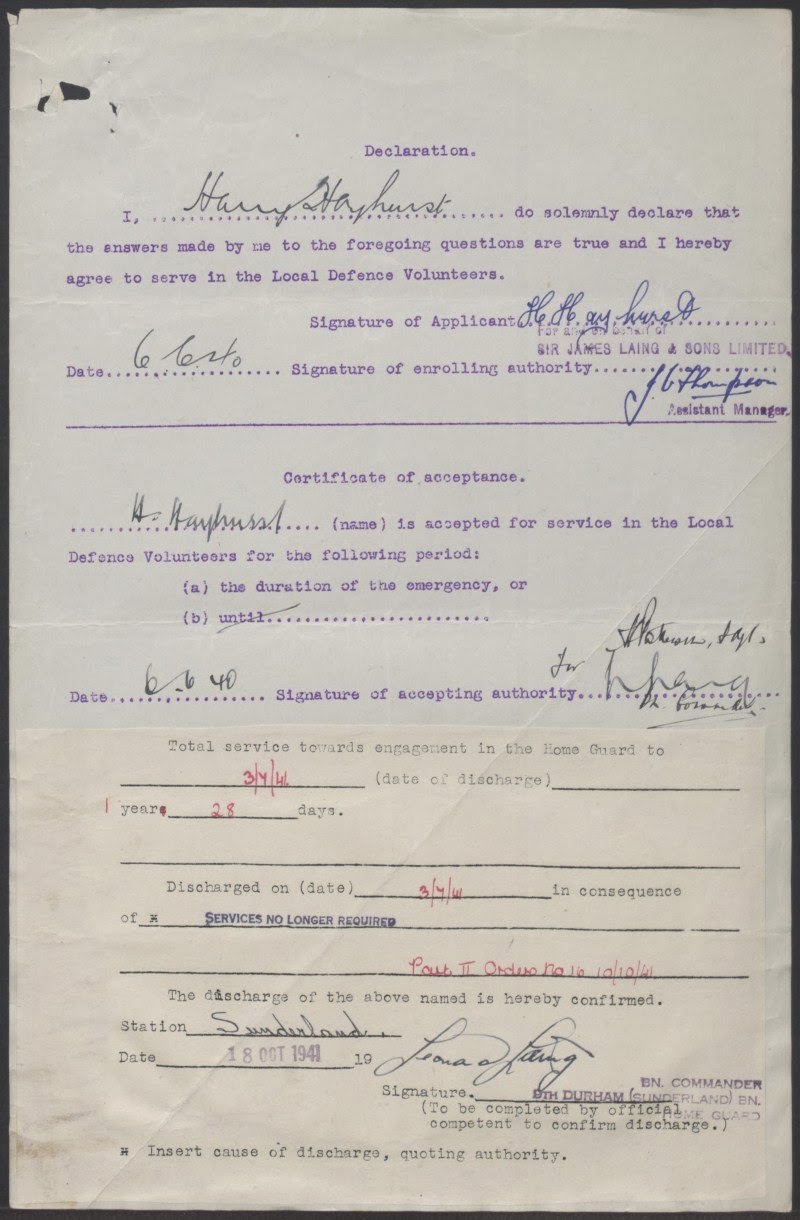
It may seem incredible to us today, but many of those who had seen the horrors of one war were willing to sign up again, if anyone would have them. You see, the television programme Dads Army is closer to the truth that you think. If you are living within the old County Durham boundaries then you might be able to find out for yourself, because the County Durham records of the Local Defence Volunteers (LDV), which later became the Home Guard have been made available on-line by the National Archives.


I've mentioned my grandfather before, and of how he was a regular soldier, wounded at Ypres in 1915 and how he ended up serving, first in the Tyne-Tees Coastal Defence force, and later the Army Service Corps and how he made his home in Sunderland. Sadly his army records are among the many lost what the warehouse was bombed in 1940, but I recently found his LDV enrolment papers from June 1940.


Sunday, November 11, 2012

Remembrance isn't what it used to be


As we approach the centenary of the start of the First World War, our government has finally announced that some form of commemoration will take place. This is stark contrast to our former allies, and even some of our former enemies, whose plans have been in place for years.

And what form will this “commemoration” take place. Will it be like the 50th Anniversary of the end of the Second World War, when the word “Celebration” was banned, and all events had to be low key, no smiling allowed.

Sometimes I wonder how we got like this. It certainly doesn’t seem to be the wish of those involved. Read the words of a First World War solder, Charles Carrington, complaining about how remembrance for him was a joyous thing, and how he felt it had been hijacked.

The first Armistice Day had been a carnival; the second Armistice Day, after its solemn pause at the Two Minutes' Silence which King George V was believed to have initiated, was a day of festivity again. For some years I was one of a group of friends who met, every Armistice Day, at the Cafe Royal for no end of a party, until we began to find ourselves out of key with the new age.

Imperceptibly, the Feast-Day became a Fast-Day and one could hardly go brawling on the Sabbath. The do-gooders captured the Armistice, and the British Legion seemed to make its principal outing a day of mourning. To march to the Cenotaph was too much like attending one's own funeral, and I know many old soldiers who found it increasingly discomforting, year by year. We preferred our reunions in private with no pacifist propaganda.”

Strong words, but typical of the soldiers of the day. If you asked them, they would not recognise the war depicted by poets and artists, they did not see themselves as the lost generation. They were extremely proud to have served, and taken part in the greatest series of victories in the history of the British Army, which were achieved between August - November 1918.

Thursday, November 10, 2011

At This Time Of Year

We're not so old in the Army List,
But we're not so young at our trade.
For we had the honour at Fontenoy
Of meeting the Guards' Brigade.
'Twas Lally, Dillon, Bulkeley, Clare,
And Lee that led us then,
And after a hundred and seventy years
We're fighting for France again!

From The Irish Guards by Rudyard Kipling

Coalition is the way of things in modern conflicts. It’s been 29 years since Britain fought a war alone, and more than a century to the one before that.

But fighting a war as part of a coalition can throw up some strange alliances. People traditionally thought of as “the enemy” can suddenly become allies and vice versa. Britain’s traditional enemy was always France, and yet in the two great wars of the 20th Century France was our ally. Similarly we generally regarded Germany as an ally and yet …

For example :

The author JRR Tolkien (Lord of the Rings etc.) served as an officer in the Lancashire Fusiliers in 1916 and with his language skills he was often called on to question prisoners. He told of a conversation with a German soldier from the Hanoverian Regiment. The soldier pointed out the irony of how at the battle of Minden on 1759 his Hanoverians fought shoulder to shoulder with Tolkien’s Lancashires against the French.

And lets not forget that while British losses between 1914 and 1918 were 704,803 some of our allies (and enemies) losses were beyond comprehension.

Russia 1,811,000

France 1,397,800

Italy 651,000

Serbia 275,000

British Empire 251,900

Romania 250,000

USA 126,000

Belgium 58,637

Greece 26,000

Portugal 7,222

Japan 415

And from the Central Powers

Germany 2,050,697

Austria 1,100,000

Turkey 771,844

Bulgaria 87,500

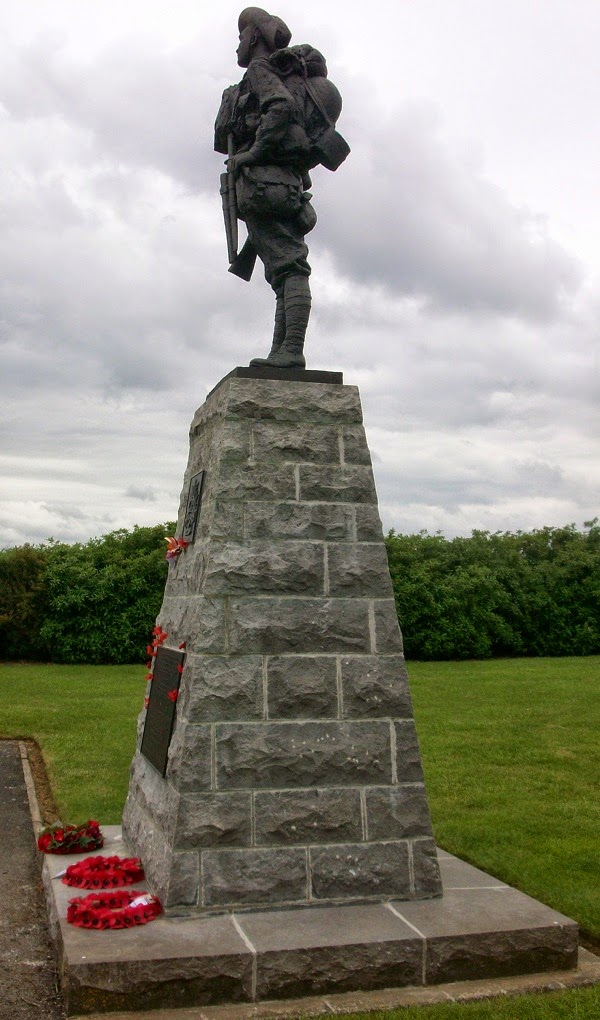
I was reminded of this many years ago when I came across this war memorial in Venice. It commemorates the Italian soldiers who lost their lives fighting against the Austrians and Germans between 1915 and 1918. Note that Italy (and Japan too) fought with us in that conflict.


Wednesday, November 10, 2010

The Unknown Warrier

The tumult and the shouting dies;
The Captains and the Kings depart;
Still stands Thine ancient sacrifice,
An humble and a contrite heart.
Lord God of Hosts, be with us yet,
Lest we forget - lest we forget.


From "Recessional" by Rudyard Kipling


You have probably never heard of David Railton, but his idea touched the hearts of many.

In 1920 he was a vicar in Margate and when the Cenotaph in Whitehall was unveiled he was reminded of a time, back in 1916 when he was an army chaplain. He had been conducting a burial service somewhere near Armentieres and in the back garden of his billet, very close to the house, was a grave marked by a rough, white cross. On the cross was inscribed in black pencilled letters: 'An Unknown British Soldier'.

The scene at the Cenotaph spurred him to put his thoughts into action. He wrote to the Dean of Westminster, Bishop Ryle, asking whether he would permit the body of an unknown soldier to be buried in Westminster Abbey. The Dean responded warmly to the suggestion and wrote to the King. Initially the King was not responsive to the idea, perhaps thinking that two years after the end of the war it may reopen the war wound which time is gradually healing.

But the Dean was undismayed. He now wrote to the Prime Minister, Lloyd George, and to the C.I.G.S. (Chief of Imperial General Staff, Field Marshal Sir Henry Wilson). They took up the idea with enthusiasm and reluctantly the King gave his assent. An announcement was made in the House of Commons and Lord Curzon, the Foreign Secretary, was appointed chairman of the cabinet committee responsible for the ceremony.

In October 1920, the G.O.C. in France & Flanders was Brigadier-General L.J. Wyatt. As such, it was he who issued the necessary instructions and it was he who selected the body.

According to the Brigadier he gave orders for four unidentified bodies of British soldiers to be brought in, one from each of the main battle areas: Ypres. the Somme, Arras and the Aisne (some reports say six bodies). They were brought in on the night of 7th November and placed in the hut which served as the chapel for the garrison. The parties that brought the remains in. returned immediately to their respective areas so they had no way of knowing which body had been chosen.

At midnight, accompanied by a senior member of his staff, he entered the chapel and selected one of the bodies which lay on stretchers covered by Union Jacks. The other bodies were taken out and buried in the nearby British military cemetery of St. Pol-sur-Ternoise.

The remains were placed in the casket brought over from Britain, bearing the inscription:

'A British Warrior who fell in the Great War 1914-1918'

The next day the Unknown Warrior began the last stage of his journey home, beginning with speeches from prominent French politicians before travelling with an escort of British and French cavalry to the quayside to board HMS Verdun At 3.30 pm H.M.S. Verdun came alongside at the Admiralty Pier, Dover and as she did so a nineteen gun salute was fired from Dover Castle and the band played 'Land of Hope and Glory'. Six warrant officers representing the various services carried the coffin off the ship and handed it over to six senior officers who acted as pall bearers.

Three hours later the train drew into Victoria station where a guard of honour from the 1st Grenadier Guards waited. The body remained in the station in the funeral coach that night, watched over by a guard from the Grenadiers.

Just before 10 o'clock on November 11th the procession started from Victoria led by massed bands, the drums muffled and encased in black. On either side of the coffin marched four Admirals, four Field marshals, three Generals and an Air Marshal.

At 10.40 am the King came out from the Home Office accompanied by the Prince of Wales, the Duke of York, Prince Henry (later to become Duke of Gloucester) and the Duke of Connaught. He took up his place with his back to the Cenotaph, still shrouded with Union Jacks. Queen Mary, Queen Alexandra the Queen Mother and Queen Ena of Spain watched from the Home Office balcony. As Big Ben sounded quarter to the hour the head of the procession passed the Cenotaph and gun carriage swung round across the road and stopped immediately in front of the King with the pall bearers drawn up in line behind it. The King stepped forward and laid a wreath on the coffin, bearing a card with the following inscription in the King's handwriting:

'In proud memory of those Warriors who died unknown in the Great War. Unknown, and yet well known; as dying, and beheld they live.'
George. R.I.


The last note of eleven o'clock died away and everything was still. Throughout the capital, throughout the land, across the Empire and on the seas all stood in silence. The Cornish Riviera express halted near Taplow; the Irish Mail came to a stop near Crewe. The stillness was total, the silence complete.

Then came the clear, haunting sound of the Last Post and as the notes died away the King stepped forward and laid his wreath against the Cenotaph, followed by the Prince of Wales, the Prime Minister (Lloyd George) and representatives of the Empire.
The procession now began to move towards the Abbey with the King and the Princes marching behind the gun carriage. As the bearer party entered the Abbey with the coffin they passed between two ranks of a guard of honour made up of ninety-six men decorated for gallantry, seventy four of them holders of the Victoria Cross.

The King stood at the head of the grave facing the Archbishop of Canterbury. the Dean and the Bishop of London; the pall bearers stood on either side while Lloyd George with Asquith and the members of the Cabinet were grouped in rows behind the King. During the singing the bearer party came forward, removed the wreath, side arms and helmet and the Union flag and lowered the coffin into the grave. The service continued, and at the words "Earth to earth, ashes to ashes . . ." the King sprinkled French earth onto the coffin. The grave was later filled in with earth brought over from France.

Saturday, November 07, 2009

Why we need to remember


Twixt Nieuport sands and the eastward lands where the Four Red Rivers spring,
Five hundred thousand gentlemen of those that served their King.

All that they had they gave - they gave -
In sure and single faith.
There can no knowledge reach the grave
To make them grudge their death
Save only if they understood
That, after all was done,
We they redeemed denied their blood
And mocked the gains it won.


From "The Kings pilgrimage" by Rudyard Kipling


There is a lot being said at the moment about wounded soldiers, and I think it's important to remember that once our Government sees sense and gets out people home, those in need won't just go away. I found some facts about First World War veterans, twenty years after the end of the war, and they make sobering reading.

In 1938 which was twenty years after the cessation of hostilities, there were still 442,000 men still alive who were so maimed, gassed, nerve-racked, or otherwise ruined in health, that they could not work at all, or only with diminished efficiency, and were wholly or partly dependent on the State for money to live.

Over one hundred and twenty seven thousand widows still mourned their men that they had last seen in uniform, and two hundred and twenty four thousand parents and other dependants were still suffering through the loss of sons and relatives who were their breadwinners. There were 8,000 with one or both legs missing, 3,600 with one or both arms missing, together with 90,000 with limbs damaged to a marked degree.

Ten thousand men had eyesight injured by poison gas, and explosions, with 2,000 of these being completely blind.

Head injuries accounted for 15,000 with many wearing metal plates to protect them, and 15,000 had been deafened by explosions of various kinds. Most soldiers who had served near the front line, or in the artillery suffered from some impairment of their hearing.

There was no such thing as industrial deafness, being recognised as a pensionable disease in those days.

Severe exertion due to heavy labour in the trenches produced Hernias in 7,000 men making them unfit for manual work, whilst some 2,000 still suffered the effects of Frostbite with in some cases loss of toes and fingers.

Thirty two thousand more suffered from various unclassified wounds causing disability of various kinds. Many of these men (14,000) still had wounds unhealed that required treatment including amputation even at this late stage. Much of this was due to a condition called Latent Sepsis which was very common in the wounded of the Great War especially in France and Flanders. Almost without exception soldiers wounded on the Western Front had wounds which were grossly infected, due to the manured soil in which they occurred. Even after these wounds had healed, many still contained organisms deep within the tissues which were liable to flare up, many years after, to cause amputation and even death.

These are the figures for the wounded, but the legacy of diseases contracted during their service, such as Malaria, Dysentery, and other tropical diseases, still persisted in 1938, the year before the next great conflict began.

One hundred thousand men were afflicted with diseases too numerous to classify, with 41,000 suffering from bronchitis and tuberculosis often as a result of gassing.

Consumption, or pulmonary tuberculosis of the lungs to give it its medical term, was rife in the Royal Navy especially in the submariners. This filled many sanatoriums after the War, with something similar occurring after the Second World War but not on the same scale.

Heart disease in addition to hernia affected 38,000 due to excessive labour at the front, with the terrible conditions of the front line convincing the not too easily convinced Ministry of Pensions doctors that the 28,000 cases of severe Rheumatism deserved a disability pension. Many more who suffered got no pension at all, there being many cases of grave injustice done at this time. These included many of the 25,000 still suffering from shell shock and other neurasthenias, with 3,200 of these still in asylums, their minds broken beyond repair.

The cost to the country was enormous with one shilling in every pound (i.e. 5%) of the national budget still going to keep these war victims.


John

Monday, November 10, 2008

In Flanders Fields


Some of you may know that my grandfather, Harry Hayhurst was a soldier. He was a Yorkshire man and in 1911 joined the York & Lancaster Regiment.

In 1914 he was serving in Jubbulpore (Bengal) and when war was declared the army reduced their presence to a skeleton staff and handed most jobs over to Indian troops. Harry landed back in England on Christmas Eve 1914 and was shipped to France in January 1915.

The 1st York & Lancs were positioned around Ypres and on the 8th of May they defended a ridge at Frezenberg. At the start of the day they were 950 strong, and by the end just 83 were left unwounded, the most senior being a sergeant. Harry was himself seriously wounded and cut off from his battalion. After staggering down a railway line Harry found himself in a dressing station run by the Canadian Army.

The officer in charge of the Canadian dressing station was a Major, by the name of John McRae. The following year, while serving in the Somme region the newly promoted Lieutenant Colonel John McRae was moved to write these famous words :

In Flanders fields the poppies blow
Between the crosses, row on row
That mark our place; and in the sky
The larks, still bravely singing, fly
Scarce heard amid the guns below.

We are the Dead. Short days ago
We lived, felt dawn, saw sunset glow,
Loved and were loved, and now we lie
In Flanders fields.

Take up our quarrel with the foe:
To you from failing hands we throw
The torch; be yours to hold it high.
If ye break faith with us who die
We shall not sleep, though poppies grow
In Flanders fields.

For those who want to know such things, Harry was shipped back to Britain and was sent, first to a hospital in Nottingham and then to Sunderland. There are no records of which hospital but it likely that the Sunderland hospital was a wartime rehab centre for gas victims. During his time there, Harry met and married one Mahala Primrose Francis and made Sunderland his home. Sadly he died in 1956, aged just 66. Lt. Colonel McRae died from pneumonia in 1917.
John

Saturday, November 10, 2007

On the 11th hour of the 11th day of the 11th month

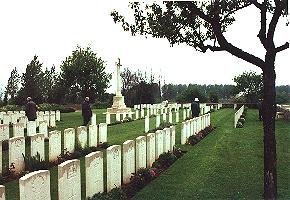
Benouville Cemetery, Normandy

Why do you still march old man, With medals on your chest ?
Why do you still grieve old man, For those friends you laid to rest ?
Why do your eyes gleam old man, When you hear the bugles blow ?
Tell me why you cry old man, About those days so long ago ?

Saturday, November 11, 2006

Rememberance

Remembering today those British servicemen who fell in two world wars and later conflicts.

744,330 from World War I
397,762 from World War II
16,000+ from Later conflicts


With proud thanksgiving, a mother for her children,
England mourns for her dead across the sea.
Flesh of her flesh they were, spirit of her spirit,
Fallen in the cause of the free.

Solemn the drums thrill: Death august and royal
Sings sorrow up into immortal spheres.
There is music in the midst of desolation
And a glory that shines upon our tears.

They went with songs to the battle, they were young,
Straight of limb, true of eye, steady and aglow.
They were staunch to the end against odds uncounted,
They fell with their faces to the foe.

They shall grow not old, as we that are left grow old;
Age shall not weary them, nor the years condemn.
At the going down of the sun and in the morning
We will remember them.


They mingle not with their laughing comrades again;
They sit no more at familiar tables at home;
They have no lot in our labour of the day-time;
They sleep beyond England’s foam.

But where our desires are and our hopes profound,
Felt as a well-spring that is hidden from sight,
To the innermost heart of their own land they are known
As the stars are known to the Night;

As the stars that shall be bright when we are dust,
Moving in marches upon the heavenly plain,
As the stars that are starry in the time of our darkness,
To the end, to the end, they remain.

— Laurence Binyon (1869-1943)